
 Tags: D365FO, e-Invoice, Electronic reporting, Full Edition, ZUGFeRD
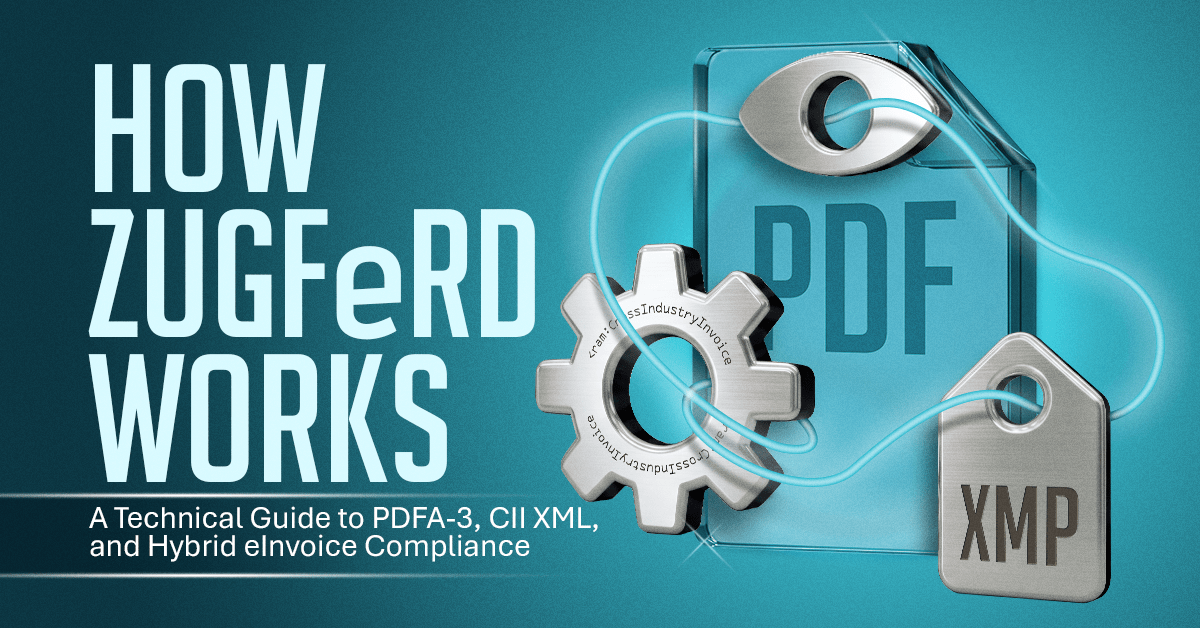
If you work with electronic invoices in Germany or across the EU, you may already know ZUGFeRD.
This article explains what ZUGFeRD is, what components it requires, and how it relates to UBL, XRechnung, and Factur-X.
Learn more about ZUGFeRD and Factur-X compliance >>.
Navigating e-Invoicing terminology
The electronic invoicing landscape is full of acronyms, overlapping standards, and regional requirements that can easily confuse anyone. In this section you can learn how ZUGFeRD compares to other essential e-invoicing terms you will encounter.
If you are familiar with the basics, jump directly to explanation what ZUGFeRD is. You can always return here later!
ZUGFeRD vs. Factur-X
ZUGFeRD originated in Germany and Factur-X originated in France. From a technical point of view, they are interoperable formats.
Both standards use PDF/A-3, embed CII XML, follow EN 16931 and use the same schema and validation rules.
Factur-X is mandated by the French public sector via Chorus Pro. In parallel, ZUGFeRD is widely used for German B2B and B2G (Business-to-Business/Government) invoicing ecosystems.
UBL vs. CII
Both UBL (Universal Business Language) and CII (Cross Industry Invoice) express the same EN 16931 semantic model, but differ in details:
| UBL | CII | |
|---|---|---|
| Creator | Created by OASIS | Created by UN/CEFACT |
| Structure | Flatter, simpler XML structure | Deeply structured, semantic XML |
| Ecosystem | Widely used in Peppol | Used in ZUGFeRD and Factur-X |
| Adoption | Strong adoption in Nordic countries | Preferred for EN 16931 in regulatory contexts |
| Design Goal | Focus on ease of implementation | Designed for cross-industry precision |
Think of them as two dialects of the same language. You choose one or another based on your ecosystem (e.g. Peppol favors UBL).
ZUGFeRD vs. XRechnung
XRechnung is the German CIUS (Core Invoice Usage Specification) of EN 16931 used in public procurement.
Key differences:
- XRechnung is pure XML.
- ZUGFeRD is a hybrid PDF with embedded XML.
If you're invoicing German public sector, stick to XRechnung XML. For private B2B, ZUGFeRD's hybrid format often wins because recipients get both readable PDF and the data. For B2G in Germany, XRechnung is mandatory. ZUGFeRD can be used in B2B and, depending on context, may also be accepted in public sector workflows.
What is ZUGFeRD?
ZUGFeRD stands for 'Zentraler User Guide des Forums elektronische Rechnung Deutschland', but you don't need to remember that! It's simply a smart way to package an invoice so people can read it easily while software can process it automatically, combining:
- A human-readable invoice in PDF format.
- A machine-readable XML e-invoice embedded into PDF invoice.
- Structured XMP metadata describing the content inside the PDF.
The result is a single file that can be:
- Read by a person.
- Processed automatically by ERP or accounting system.
- Archived long-term in a compliant format.
That is why ZUGFeRD is called a hybrid invoice.
Core components
A ZUGFeRD invoice consists of three elements:
PDF/A-3 document
PDF/A is an ISO-standardized version of PDF for archiving that allows file attachments.
This is essential because the structured XML invoice is embedded inside the PDF.
Supported conformance levels:
- PDF/A-3a
- PDF/A-3b
- PDF/A-3u
The PDF must pass formal PDF/A validation.
Embedded CII XML (Not UBL)
The structured invoice data is stored as XML file inside the PDF.
ZUGFeRD uses:
- EN 16931 semantic model
- UN/CEFACT Cross Industry Invoice (CII) syntax
All business data, such as amounts, tax details, seller, buyer, and line items, must be present in this XML file.
XMP metadata
XMP (Extensible Metadata Platform) is a metadata format embedded directly inside the PDF file, with a purpose to provide machine-readable description of the document. It is a strictly validated content, mandatory for PDF/A.
ZUGFeRD requires specific XMP properties:
- DocumentType: declares the document type.
- DocumentFileName: specifies the embedded XML filename.
- Version: indicates the ZUGFeRD version.
- ConformanceLevel: defines the conformance profile.
You can include additional attachments in the PDF. However, there must be exactly one invoice XML referenced by the XMP metadata.
Conformance profiles
Conformance profiles define how much structured data your invoice must contain.
They control the level of detail in the embedded CII XML and determine suitability for different scenarios:
- simple consumer invoices (B2C),
- standard business trading (B2B),
- or public sector procurement (B2G)
ZUGFeRD 2.x and Factur-X 1.0.x support the following profiles:
- MINIMUM: minimal structured data. Suitable for very simple invoices, typically low-complexity B2C or basic B2B scenarios.
- BASIC WL (Without Lines): similar to BASIC, but without structured line-item data in the XML. Limited automation potential.
- BASIC: entry-level structured invoice with line items, taxes, and totals. Suitable for standard B2B scenarios, but not fully aligned with all EN 16931 public procurement requirements.
- EN 16931: fully compliant with the European Norm EN 16931. Required in most public sector (B2G) scenarios within the EU.
- EXTENDED: EN 16931 plus additional structured extensions. Used in complex B2B environments where extra industry-specific data is needed.
For public sector compliance, EN16931 profile is typically required.
Choosing the correct profile is critical. The XMP metadata (ConformanceLevel) and the XML must match exactly, or validation fails.
Need to create ZUGFeRD invoices?
If you want to generate ZUGFeRD-compliant invoices directly from Dynamics 365 F&O, read our guide on how to create ZUGFeRD invoices with Docentric.
👉 Learn how to Configure and Generate ZUGFeRD Invoices in D365FO with Docentric.